Posts

Showing posts with the label Whales in General

Inflated whale carcass mistaken for capsized ship

Image
The body of a dead and rotting Bryde’s whale, inflated from the gases of its decomposition, was mistaken for a capsized ship as it drifted toward the South African coast. Shark warning in southern Cape   – News24 Whale carcass washes up on rocks   – Independent Online Whale carcass washes ashore in S.Africa   – AFP S. Africa issues shark warning around washed-up whale   – AFP

Comedian Jim Gaffigan on whales

Image
 

In the UK, whales belong to the Crown — even when beached

Image
In the United Kingdom, whales are considered “ royal fish ,” and as such, they belong to the Crown upon being caught or landing upon the English shore. The rules evidently apply to dead and rotting beached whales, too.  In the BBC News article  What happens after a whale is beached? , reporter Caroline Lowbridge describes how beached whales are (supposed to be) handled in the UK. British law goes so far as to specify that the King gets the head and Queen gets the tail. Lest you think the Queen comes out behind on the deal, the queen “received the tail in order to be supplied with whalebone for her corsets and stays,” according to Wikipedia. (However, there is some confusion here;  Moby Dick  author Herman Melville claimed that “whalebone” was actually baleen, which comes from the  mouths  of certain whales.) Anyway, it’s not clear to what use the King may have put the whale’s head. The article covers a number of other whale incidents in the UK and then wrap...

A book about a blob

Image
Here’s a book that may be of interest to Exploding Whale aficionados:  The Life Story of a Chilean Sea Blob and Other Matters of Importance  by  Theodore Carter . For those of you that may be unfamiliar with the term, a “sea blob” — also known as a “ globster ” — is an “unidentified organic mass that washes up on the shoreline of an ocean or other body of water.” The title of the book refers to a  highly publicized event in 2003  where one such “organic mass” washed up on the coast of Chile. Biologists were unable to readily determine what the “blob” was, and the world had to wait nearly a year before DNA testing revealed it to be the remains of a sperm whale.  Many such events  have occurred over the decades with the remains often misidentified as sea monsters, giant octopuses, or modern-day plesiosaurs. Carter has apparently worked the Chilean sea blob into a collection of short stories, which his publisher describes as follows: Much as Theodore Cart...

Blown-Up Whales

Image
Inflatable whales  gathered around Sydney Harbor, Australia, to mark the start of the annual whale migration season in that area.

Dead Whale on Pacific Beach to be buried

Image
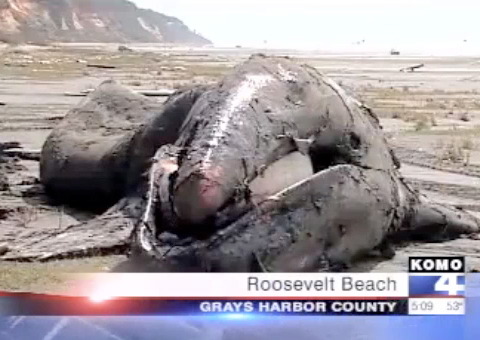
A popular beach on the Washington coast became home to a dead gray whale, and the state moved quickly to bury the carcass before scores of clam diggers were to arrive just two days later. The 38-foot female was the third whale to wash up in the area in recent years. In the report linked below, the reporter makes explicit mention of Oregon’s Exploding Whale: “I think it’s the best thing they can do, unless they can take it out there and let the fish eat it or whatever,” she said. That’s wouldn’t work; it would just come back with the tide. And everyone knows that blowing it up is a lousy idea. They tried that, with disastrous results some years back in Florence, Oregon. Media links: Article:  ‘The most horrible smell you’ve smelled’: Dead whale washes ashore   – KOMO News Video:  ‘The most horrible smell you’ve smelled’: Dead whale washes ashore   – KOMO News Archived copy of the video from the Exploding Whale video portal on YouTube:

Sick Humpback killed by explosives in South Africa

Image
Details are few, but a humpback whale was euthanized with explosives on September 29, 2010, after stranding on a reef near Struisbaai Harbour, South Africa. It was determined that the 30-foot whale was sick and had little chance of survival. Links to a couple news articles are available on our permanent archive page: South Africa (9/29/2010)   – TheExplodingWhale.com

Stranded whale blown up

Image
  Thanks to reader David R., we’ve learned about a stranded humpback whale that was euthanized via an explosive charge. The sick 31-foot, 12-ton whale had been stuck in Princess Royal Harbor in southwestern Australia for two weeks. Authorities imposed a 1-km exclusion zone around the whale before detonating a charge directly above the whale’s brain. Officials plan to bury the carcass. Stranded whale in Albany’s Princess Royal Harbour euthanased  ( video )  – PerthNow Stranded whale blown up   – WA Today Stranded whale in WA killed with explosives   – PerthNow Blown Up: Stranded Whale Is Put To Death   – Sky News Stranded whale goes out with a bang   – Sydney Morning Herald Stranded whale to be blown up in harbour   – ABC News Explosives to be used to kill whale   – United Press International Watch:  news video  from Perth Now View our permanent archive page here: Australia (9/2/2010)   – TheExplodingWhale.com

Dynamite not an option this time

Image
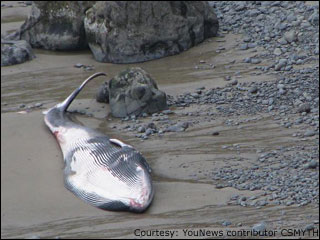
According to Oregon state officials, dynamite is not an option being considered for how to dispose of a   40-foot fin whale carcass   that washed up on an Oregon beach over the weekend.   The carcass came to rest on an easily-accessible beach just a few miles north of where a giant sperm whale corpse washed up in November, 1970. The Oregon Highway Division had responsibility for disposing of the whale at that time, and their thinking was evidently along the lines that a dead whale was probably a lot like a huge boulder blocking a road construction project. The decision to use dynamite to obliterate the rotting, stinking whale carcass is now stuff of legend. Regrettably, cooler heads prevail at the Oregon Parks and Recreation Department, upon which the responsibility for disposing of the rare 40-foot fin whale falls today: “We normally bury animals like this on the coast,” said Chris Havel, a state parks spokesman. “But the sand there is so shallow that burying just isn’t ...

Whale perishes on Oregon Coast

Image
The  Sei  fin whale observed struggling in the surf along the Oregon Coast  on Friday, March 6, 2009, is believed to have died and washed up close to where officials lost sight of it late Friday afternoon. Update:  Biologists now believe that the  50 40-foot whale that died along the Oregon Coast was, in fact, an endangered  fin whale , not a Sei whale as originally reported. They also predict that the whale appeared undernourished and was probably chronically ill. A  video report  (in which it is still described as a Sei whale) is available. A  more recent video  is also available. Parallels to  Oregon’s infamous exploding whale  are  already being made , of course. However, state officials have indicated they have no intention of blowing up the carcass. External links: Struggling whale likely same one found dead   – KVAL Struggling whale washed up dead near Florence   – The Oregonian Marine biologists search fo...

Whale struggling on Oregon Coast

Image
A whale, possibly entangled in the line from a crab pot, is struggling in the surf near Florence, OR. Officials believe it is a  Sei whale  measuring between 40-50 feet.  Stay tuned for updates on this developing story…. Update:  Watch  video from KVAL  in Eugene, OR. Updates: As of Saturday morning, the whale’s whereabouts are unknown. Read the  Coast Guard news release  regarding the whale. Watch  Coast Guard video  of the whale taken Friday, 6-March-2009. See  “Fin whale perishes on Oregon Coast”  for additional updates on this story. External links: Officials Fear Whale Near Florence Tried to Reach the Beach  – Salem-News.com Would-Be Beached Whale Appears to Be OK   – KTVL Coast Guard whale watching   – Register-Guard Whale appears to be in a life or death struggle, it’ll be touch and go   – KVAL Whale update : “Blood was coming up with the animal’s body”   – KVAL Coast Guard keeping tabs on injure...

TV Alert! “The Whale that Exploded” to air Dec 13 & 15

Image
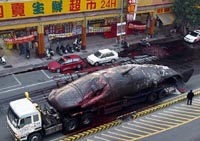
A British documentary titled “The Whale that Exploded in the Street,” will be airing in the United States on December 13 and 15 on the National Geographic channel (aka “NatGeo”) under the shortened title, “The Whale that Exploded.” The documentary explores the explosion of a 50-ton sperm whale carcass that was being transported through the Taiwan city of Tainan on a flatbed truck in January 2004. The explosion flooded a city street with gallons of blood and piles of intestines.  The documentary is of particular interest since the  producers asked for permission to use screenshots of this website’s page  documenting the event .  The show is schedule to air as part of NatGeo’s “ Wild ” series at the following times: December 13, 2008, at 8pm December 15, 2008, at 8am See the the  program’s page  on the  NatGeo TV  website for more information. Update:   Monsters and Critics  also a brief mention of the program.

Video: Jurien Bay exploding whale

Image
Here’s  a video from TheWest.com.au  on the Jurien Bay exploding whale. (Note: while the video does show the whale thrashing in the surf, it does  not  contain any graphic images either during or following the explosion.)

Initial explosive charge failed to kill stranded whale

Image
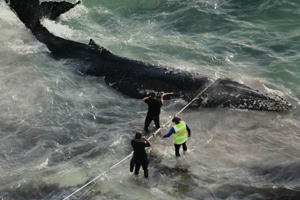
In a sad and gruesome twist, the initial explosive charge set off directly above the brain of a stranded juvenile humpback whale in Western Australia failed to kill the animal. After the whale continued thrashing for several minutes, a wildlife officer began firing several shots into its head, as can be seen in the photo above. After a total of 15 minutes, a second charge was detonated, finally killing the suffering creature. This was really the worst possible outcome of the decision to euthanize this stranded whale. Really, once you’ve made that decision, can there be such a thing as using  too many explosives ? I mean, if your plan is to “put it out of its misery,” then why not just plan to blow it to kingdom come? If you think X pounds of explosives is enough, why not just use 5X for good measure?  And if the explosives didn’t kill it, why would they then think that shooting it full of bullets for 15 minutes was going to finish the job?  The thought processes that lead...

Whale euthanized with explosives

It’s been almost exactly three years since the  last time  explosives were used to end the life of a suffering whale. This merciful act has happened again today, September 30, 2008, in West Australia. Explosives have been used to put down a dying 15 tonne humpback whale stranded in shallow waters at Jurien Bay. The whale thrashed its tail for at least five minutes after the blast, which was authorised by the Department of Environment…. Department of Environment spokesman Nigel Higgs confirmed the whale’s death just after 5pm. “We have just euthanised the whale and we will propose to bury it on site,” Mr. Higgs said. The whale was euthanised by a technique which caused an implosion into its brain. “It went as well as it can be expected, it is a big animal,” Mr Higgs said. A 1km exclusion zone was enforced around the whale while the procedure took place. Not surprisingly, the act was condemned by a former whale rescuer and animal activist: The veteran animal campaigner said the ...

Explosive charge to end stranded whale’s life in Western Australia

Image
Wildlife officials in Australia are planning to euthanize a dying, stranded whale with an explosive charge directed into the creature’s brain. The 16-ton juvenile humpback whale has been stranded for five days in  Jurien Bay  in Western Australia and is believed to be either sick or injured.  Officials had originally planned to keep the whale as comfortable as possible and let it die on its own. “The whale is so weak that it can’t be rescued and moving such a large animal is not possible without causing it significant damage and distress, and it is too big to euthanase,” [senior wildlife officer] Mr. Coughran said. But five days later, the whale was still alive. “It’s taking a while to die,” Mr. Coughran said. “What we’ve been doing is monitoring the process and now it’s getting to a stage where its condition is such that we can seriously consider efficient and instantaneous ways to euthanise it.” Those in charge are “now looking to end the 10m animal’s suffering by deton...

Whale carcass on UK beach is explosion risk

Image
The carcass of a dead  minke whale  that washed up on the  west coast of England  is at risk of exploding as gases released by the rotting flesh collect inside the whale. Minke whales are common in the waters around the UK, but carcasses rarely wash up in this area. As a result, the dead leviathan has attracted numerous onlookers.  Scientists have been taking samples from the carcass and are set to release the build up of gas from the creature’s body to prevent it from exploding. Whale carcass washes up on beach   – BBC News Minke whale washed up   – Liverpool Echo Photos of the whale carcass Whale carcass washes up on beach Scientists from Liverpool University have been studying a whale which was washed up on the Merseyside coast. The nearly fully grown male minke whale was already dead when it was beached near Formby over the weekend. No one is sure how the creature died but the decaying carcass has become a macabre tourist attraction with hordes of ...

Bevy of bystanders beholds birth of baby beluga in BC

Image
And now for the very best kind of “exploding” whale… From  BBC News : After 15 months of pregnancy, Qila the Vancouver Aquarium’s 12-year-old beluga whale has given birth to her first calf. The birth was captured live by television cameras. Qila was the first beluga whale to be conceived and born in a Canadian aquarium. She has remained in the aquarium with her mother Aurora, who is 21 years old.  BBC news also has a great  video of the birth .  Next, Jon Murray of  The Province  has a nice  gallery of photos : Finally, the  Vancouver Aquarium  has posted an official  announcement  of the birth as well as their own  video on YouTube : And if you just can’t get enough of this baby beluga, tune into the Vancouver Aquarium’s “ belugacam ” — not to be missed!

SoCal Whale Disposal Dilemma

Image
Southern California has recently been confronted with figuring out how best to dispose of a huge, 60-ton blue whale carcass. The rotting hulk was towed into harbor for examination by scientists on September 22, and after being dissected and having several internal organs removed, the whale was towed out to sea. A few days later, it washed up on a Malibu beach where lifeguards had a go out at the stinking leviathan. They also tried towing it out to sea in hopes that it would sink, but as of October 4, it had returned to a Malibu sandbar. A  recent article  in the  LA Times  did a nice job of surveying the undesirable disposal options. Naturally, Oregon’s Exploding Whale was cited early on in the article: What to do with a dead whale is no small problem…. Blow it up and you just might end up showering blubber on hapless spectators, as did the state of Oregon in a 1970 incident still kept pungently alive on the Internet and in columns by humorist Dave Barry. (“pungently...

Norwegians fear carcass may explode

Image
“Well, I wouldn’t exactly call it an explosion, but it can be like an enormous fart. It would be quite unpleasant if the stomach blows up. It’s not very nice to have rotten whale parts showering over you.” These comments were made by Tore Haug of the  Norwegian Marine Research Institute  in Bergen as he described a very foul-smelling whale carcass that has found its way into a Norwegian fjord.  Mr. Haug certainly sounds as though he’s rather well-schooled in our favorite topic. Unfortunately, much of Norway is “familiar” with whales in a way that defies the international community. Perhaps this is how the whales strike back against Norway’s ongoing  commercial whaling  industry. As for the photo, I’m honestly not even sure what it’s showing. Apparently, the entire exterior of the whale carcass has turned completely white. And it really stinks. Crews were trying to prevent it from making landfall by towing it our of the fjord. Meanwhile, several jurisdictions and...